Recommended for your item
Quick shop
We use cookies to give you the best online experience. Find out more on how we use cookies in our cookie policy.
We use cookies to give you the best online experience. Find out more on how we use cookies in our cookie policy.
To find out more visit our Privacy Policy
Because this product is a pre-order item you'll be charged immediately.

Why does one 8x10 rug cost $400 and another $4,000? The difference is construction. Here's how to tell hand-knotted from machine-made and tufted rugs, what each one is honestly good for, and why knotted rugs are the ones that get passed down.
Shop for an 8x10 rug and you'll find one for $400 and another, which looks similar in a photo, for $4,000. Nobody explains the difference, so most people quietly assume the expensive one has a designer name attached and move on.
The real difference isn't the name. It's what happened before the rug reached the photo, and it determines how the rug feels underfoot, how it survives a decade of real life foot traffic, and whether your grandchildren might argue over it someday. Here's the honest guide.
A hand-knotted rug is made the way rugs have been made for a few thousand years: an artisan sits at a loom and ties individual knots of wool around a foundation of warp threads, row after row, by hand. A single 8x10 rug can hold over a million knots and take months to complete. When we say a rug comes from the loom to your room, this is the loom we mean.
All that time buys you three things you can feel.
Density. Knots packed tightly against each other create a pile that springs back underfoot and resists crushing where furniture sits. This is why a well-made hand-knotted rug still looks composed after ten years in a living room.
Durability. Each knot is tied, not glued. There's no adhesive to dry out, no backing to delaminate. Hand-knotted rugs routinely serve for generations, and antique ones are bought and sold precisely because they've already proven they can.
Repairability. Because the rug is built knot by knot, it can be repaired knot by knot. A burn, a pet incident, a fringe that's seen things: all fixable by a skilled restorer. A damaged machine-made rug is, in most cases, simply a damaged rug.
Between hand-knotted and machine-made sits a family of rugs that are made by hand but not knotted. Flatweaves and handwoven rugs (including kilims and dhurries) are woven on a loom without a pile. They're lighter, often reversible, typically more affordable than knotted construction, and wonderful in dining rooms, entryways, and busy households. Many of our performance and indoor/outdoor rugs are handwoven from recycled fibers for exactly this reason: real handcraft, built for real life, at a friendlier price than knotted work.
A note on hand-tufted, which sounds similar and isn't. A tufted rug is made by punching yarn through a fabric backing with a tool, then securing it with latex glue. It's faster and cheaper than knotting, and it photographs well when new. But the glue is the rug's skeleton, and glue ages the way glue does. If a rug is described as "handmade" at a suspiciously friendly price, it's usually tufted. Check for a fabric backing glued to the underside; that's the tell.
A power loom can produce in an afternoon what an artisan produces in months. Machine-made rugs are woven at speed from mostly synthetic fibers, with perfect uniformity and low cost. That's genuinely useful: a first apartment, a budget friendly option, a rental you'll leave in a year. We'd rather see a beautiful machine-made rug in those rooms than a bare floor.
What a machine can't do is tie a knot. Machine-made construction generally means a shorter lifespan, a pile that flattens rather than springs, and no path to repair. It's a purchase, where a hand-knotted rug is closer to an acquisition for long term placement.
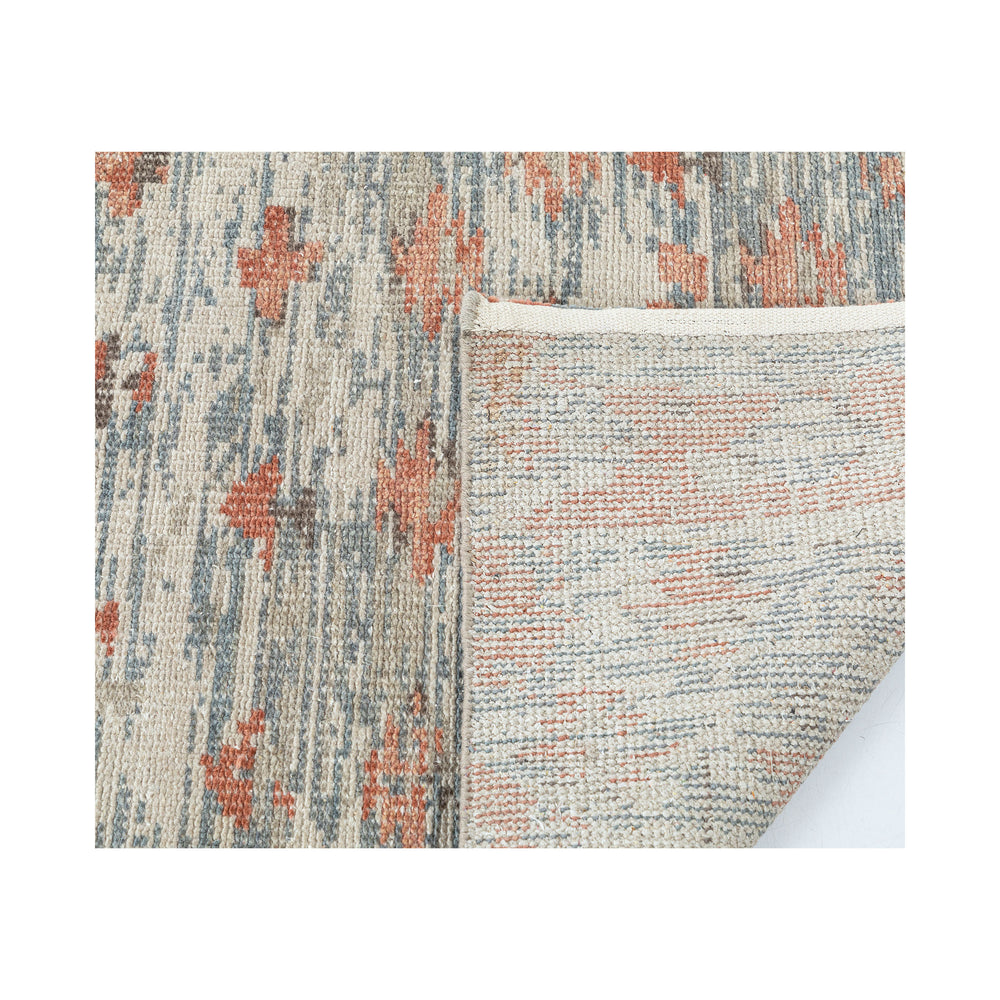
Flip the rug over. The back tells the truth.
On a hand-knotted rug, the pattern is clearly visible on the back, in slightly irregular rows of knots, like handwriting. The fringe is the actual foundation of the rug, not an accessory. On a machine-made rug, the back shows a uniform, grid-perfect weave, and the fringe (if any) is sewn on. On a tufted rug, you'll find that glued fabric backing hiding the construction entirely.
Small irregularities in a handmade rug are not flaws, by the way. They're the signature. Perfect uniformity is what machines contribute to the world; character is what hands do.
 So what are you actually paying for?
When you buy hand-knotted, the price reflects months of skilled human work, materials good enough to deserve it (in our case, wool and botanical fibers an artisan would choose for their own home), and a service life measured in decades. Per year of use, a $3,000 hand-knotted rug kept for thirty years costs less than a $400 machine-made rug replaced every four.
That math only matters if you'll keep the rug, which is why our honest advice is boring: buy machine-made or handwoven for the rooms and seasons of life that are still moving, and buy hand-knotted for the room you've settled into, in a design you'd happily look at for twenty years.
And if the design you'd happily look at for twenty years doesn't quite exist, that's the other thing hand-knotting makes possible: our custom program can take any LOOMY design and weave it in your size, your colors, or your reworking of it entirely. A machine needs a production run. A loom just needs a plan.
Construction is a touch decision, and photos are terrible at texture. Our Home Swatch Box brings the textures home so you can feel knotted wool against handwoven fiber on your own floor, in your own light. It remains the smartest first step we offer.
How can I tell if a rug is hand-knotted? Flip it over. A hand-knotted rug shows the pattern clearly on the back in slightly irregular knots, and the fringe is part of the rug's foundation rather than sewn on.
Are hand-knotted rugs worth the money? For rooms you'll live in for years, generally yes: they last for decades, resist crushing, and can be repaired. Spread over their lifespan, they often cost less per year than replacing machine-made rugs.
What's the difference between hand-knotted and hand-tufted? Hand-knotted rugs are tied knot by knot on a loom. Hand-tufted rugs are made by punching yarn through a backing and securing it with glue, which shortens their lifespan considerably.
How long does a hand-knotted rug last? With reasonable care, decades. Well-made examples regularly serve 30 to 50 years or more, which is why they're passed down and why antique rugs hold value.
Is machine-made ever the right choice? Yes. High-change rooms, rentals, playrooms, and tight budgets are all good reasons. Buy the construction that matches the room's stage of life.


